7 Best Open-Source & Self-Hosted CRMs for Privacy-Conscious Founders (2026)
Compare the best open source crm tools for 2026. Review Twenty, Erxes & Close with Docker self-hosting, 100% data residency & $0 seat costs.
7 Best Open-Source & Self-Hosted CRMs for Privacy-Conscious Founders (2026)
For technical founders, bootstrapped agency leads, and privacy-focused product teams, standard commercial customer relationship management (CRM) software represents one of the steepest operational taxations in modern software. Incumbent platforms like Salesforce and HubSpot trap growing companies in aggressive per-seat pricing matrices, restrict API access behind enterprise paywalls, and store sensitive customer contact records, deal notes, and contract negotiations across shared multi-tenant cloud databases. If you want full data sovereignty without sacrificing modern UI workflows, explore our verified directory of open-source CRM tools on MicroBaseHQ.
Across our live database, we curate 37 active platforms within our CRM & sales category. When evaluating self-hosted alternatives, founders discover that deploying modern open-source engines cuts software overhead from $150/user/month down to a simple $5–$15/month Virtual Private Server (VPS), while guaranteeing total GDPR, HIPAA, and SOC2 data residency. Whether your objective is to eliminate SaaS seat licensing or protect confidential client lists, this benchmark evaluates the 7 best open-source and self-hosted CRMs for privacy-conscious founders in 2026.
Quick Comparison: Best Open-Source & Self-Hosted CRMs (2026)
| Tool | Best For | Starting Price | Free Tier / Open Source? | Key Problem Solved |
|---|---|---|---|---|
| Twenty | Modern open-source Salesforce replacement with Notion-like UX & custom relational objects | $0/mo (Free Self-Hosted) | Yes (100% Free Self-Hosted + Free Cloud Tier) | Open Source CRM |
| Erxes | Self-hosted all-in-one customer experience, combining CRM, omnichannel marketing & helpdesk | $0/mo (Free Self-Hosted) | Yes (100% Open Source AGPL v3) | Data Ownership Concerns |
| Close | High-velocity outbound sales pipelines with built-in multi-channel calling, SMS & email sync | $19/user/month | No (14-Day Free Trial Available) | CRM Too Complex |
| Freshsales | AI-powered sales execution, predictive deal scoring & built-in cloud telephony | $0/mo (Free for 3 Users) | Yes (Free Tier for 3 Users, Paid from $9/user/mo) | Sales CRM With Calling |
| Capsule CRM | Clean, clutter-free relationship tracking and sales pipelines for small service businesses | $0/mo (Free for 250 Contacts) | Yes (Free 2 Users / 250 Contacts, Paid from $18/user/mo) | Simple CRM for Small Business |
| Attio | Relational data modeling, dynamic custom objects & automated real-time email enrichment | $0/mo (Free for 3 Users) | Yes (Free Tier Available, Paid from $36/user/mo) | Rigid CRM Workflows |
| Bigin by Zoho CRM | Ultra-lightweight pipeline micro-CRM for solo operators transitioning off spreadsheets | $0/mo (Free for 1 User) | Yes (Free for 1 User, Paid from $7/user/mo) | Full CRMs Are Overkill For Tiny Teams |
Architectural Breakdown: Self-Hosted Open-Source CRM vs. Proprietary Cloud SaaS
Understanding why engineering-led startups migrate toward an open source crm requires analyzing the underlying technical architecture. Traditional multi-tenant cloud platforms lock your relational customer records inside opaque database schemas, charge punitive fees for API throughput, and unilaterally index your private email communications to train proprietary machine learning algorithms.
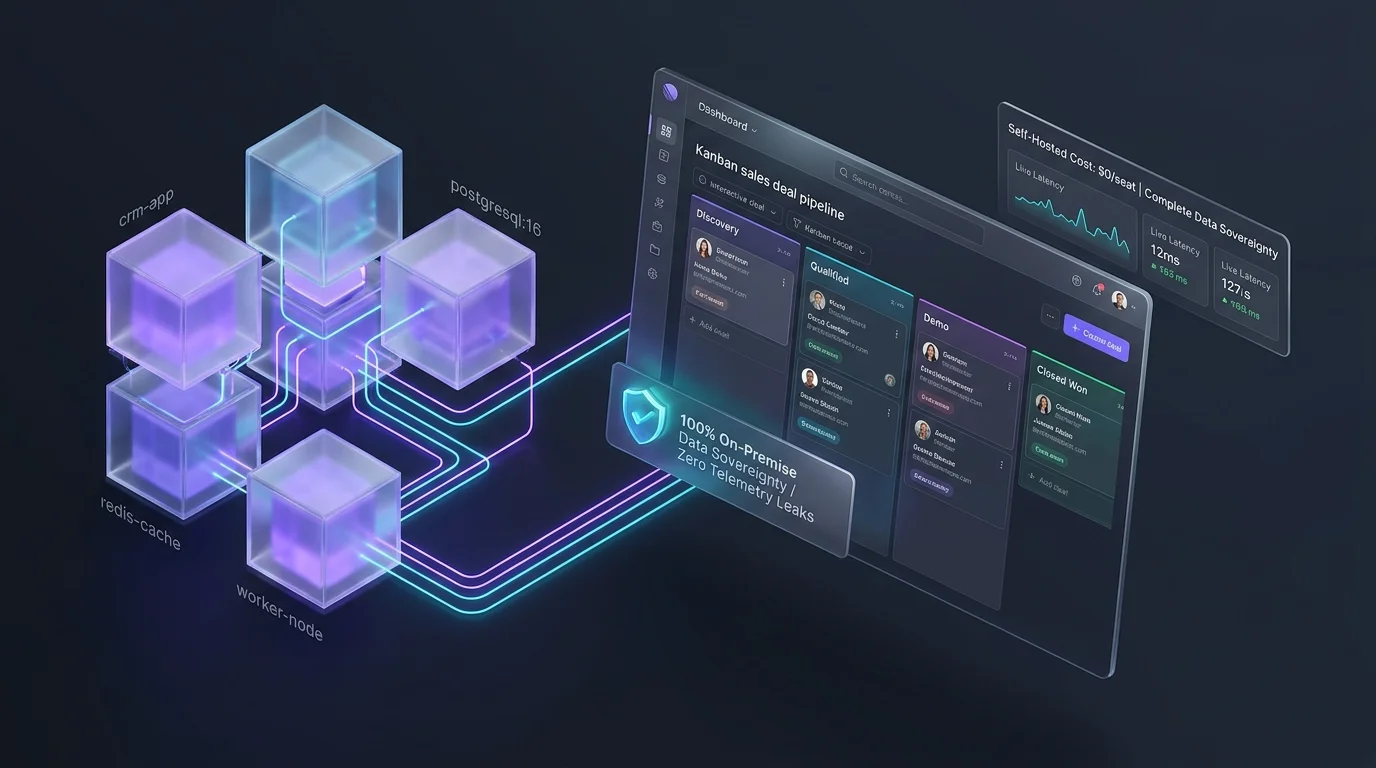
In contrast, deploying a self-hosted engine places your company in direct ownership of your PostgreSQL schemas, Redis queues, and asset storage buckets.
Self-Hosted vs. Commercial Cloud Architecture Matrix
| Architectural Dimension | Legacy Commercial Cloud (Salesforce / HubSpot) | Modern Open-Source Self-Hosted (Twenty / Erxes) | Managed Lightweight SaaS (Close / Capsule / Bigin) |
|---|---|---|---|
| Data Residency & Custody | Stored on shared third-party multi-tenant servers | 100% on-premises in your private VPC / dedicated server | Isolated tenant databases managed by vendor |
| Underlying Database | Proprietary multi-tenant relational abstraction | Standard PostgreSQL 16 with open SQL access | Managed cloud database (Postgres / Aurora) |
| Custom Object Modeling | Gated behind $150–$300/user/mo Enterprise tiers | Native custom objects & relations out-of-the-box | Flexible schema on higher tiers (Attio / Close) |
| Deployment Footprint | Closed-source SaaS (Zero infrastructure control) | Single Docker Compose stack (App, Postgres, Redis, Worker) | Multi-region managed SaaS application |
| API & Webhook Limits | Strict daily rate-limits and tiered API quotas | Uncapped GraphQL & REST APIs via local VPC network | High-throughput authenticated developer APIs |
| Annual Cost for 5 Users | $3,000 – $9,000+ per year | $60 – $180 per year (VPS hosting only, $0 software seat fees) | $1,140 – $2,940 per year |
| Telemetry & Privacy | Third-party tracking scripts & external analytics | Zero external telemetry; completely air-gappable | Standard anonymized product telemetry |
When engineering teams evaluate infrastructure migration, reviewing verified HubSpot CRM alternatives and Streak alternatives provides clarity on how modern open-source stacks bypass seat inflation while delivering superior developer ergonomics.
Production Deployment: Running an Open-Source CRM via Docker Compose
Deploying an enterprise-grade self-hosted CRM no longer requires maintaining fragile Linux package dependencies. Modern open-source solutions like Twenty encapsulate the entire backend API, frontend web client, asynchronous worker queues, and PostgreSQL database within containerized services.
Here is a production-tested docker-compose.yml configuration demonstrating how to self-host Twenty on a standard $10/month Linux VPS:
version: '3.8'

services:
  twenty-server:
    image: twentycrm/twenty:latest
    restart: always
    environment:
      - PORT=3000
      - NODE_ENV=production
      - PG_DATABASE_URL=postgres://twenty_user:SecretSecurePassword2026@twenty-postgres:5432/twenty_db
      - REDIS_URL=redis://twenty-redis:6379
      - APP_SECRET=generate-a-random-64-character-hex-string-for-security
      - SERVER_URL=https://crm.yourdomain.com
      - FRONTEND_URL=https://crm.yourdomain.com
      - STORAGE_TYPE=local
    volumes:
      - twenty_data:/app/packages/twenty-server/.local-storage
    ports:
      - "3000:3000"
    depends_on:
      twenty-postgres:
        condition: service_healthy
      twenty-redis:
        condition: service_started

  twenty-postgres:
    image: postgres:16-alpine
    restart: always
    environment:
      - POSTGRES_USER=twenty_user
      - POSTGRES_PASSWORD=SecretSecurePassword2026
      - POSTGRES_DB=twenty_db
    volumes:
      - pg_data:/var/lib/postgresql/data
    healthcheck:
      test: ["CMD-SHELL", "pg_isready -U twenty_user -d twenty_db"]
      interval: 5s
      timeout: 5s
      retries: 5

  twenty-redis:
    image: redis:7-alpine
    restart: always
    volumes:
      - redis_data:/data

volumes:
  pg_data:
  twenty_data:
  redis_data:
4-Stage Production Rollout Workflow
- VPC Provisioning & Docker Setup ➔ Spin up an Ubuntu 24.04 LTS instance (minimum 2 vCPUs and 4GB RAM) on Hetzner, DigitalOcean, or AWS EC2, and install Docker Engine with the Docker Compose plugin.
- Environment & Secret Isolation ➔ Clone your deployment repository, generate cryptographically secure tokens for
APP_SECRETand database credentials in a strictly guarded.envfile withchmod 600. - Database Initialization & Healthcheck ➔ Execute
docker compose up -d. The internal container healthchecks ensure PostgreSQL 16 migrations execute cleanly before the TypeScript NestJS application server accepts inbound traffic. - Reverse Proxy & TLS Termination ➔ Route an A-record (
crm.yourdomain.com) through Caddy or Nginx with automated Let's Encrypt SSL certificates, securing all sales communications with modern TLS 1.3 encryption.
Detailed Tool Breakdowns: The 7 Best Open-Source & Self-Hosted CRMs
1. Twenty — Best for Open-Source Salesforce Replacement & Modern Relational Workflows
[!NOTE]
Twenty Architectural Snapshot:
- Technology Stack: TypeScript, NestJS, React, GraphQL, PostgreSQL 16
- License Model: AGPL v3 (100% Free Self-Hosted Community Edition)
- Core Architecture: Notion-like fluid UI, native custom relational objects, Docker Compose ready
Why It Stands Out
Twenty is widely recognized in the developer ecosystem as the definitive open-source alternative to Salesforce. Built on a cutting-edge TypeScript, React, and NestJS architecture with a PostgreSQL foundation, Twenty completely ditches the clunky, menu-heavy aesthetic of legacy enterprise tools. Instead, it presents an ultra-responsive, Notion-inspired interface that allows founders and operators to define custom objects, fields, and relational database connections on the fly without writing backend migrations.
Because Twenty operates under the AGPL v3 license, teams can self-host the complete application on private cloud infrastructure with zero telemetry or artificial feature gates. Its native GraphQL and REST API endpoints make integrating custom internal micro-SaaS backends, billing webhooks, or automated outbound pipelines trivial.
Verified Pricing & Free Tier Limits
- Self-Hosted Community Edition: $0 forever. 100% free and open-source. Includes unlimited team members, unlimited contacts, custom objects, and full API access.
- Twenty Cloud (Managed): Free tier available for small teams; paid managed cloud tiers begin at transparent monthly rates for companies preferring managed hosting.
Problems Solved on MicroBaseHQ
- Open Source CRM: Delivers a fully inspectable, hackable codebase with an active GitHub community.
- Self Hosted CRM: Zero external third-party cloud dependencies, running entirely within your Docker or Kubernetes cluster.
- Salesforce Alternative: Replaces bloated, multi-thousand-dollar enterprise licenses with clean, modular sales pipelines.
Trade-offs & When to Skip
Twenty is evolving rapidly. While its core pipeline management, contact indexing, and custom object relations are exceptionally solid, complex enterprise telephony dialers and native visual workflow builders are still under active development. Teams requiring an out-of-the-box VoIP phone dialer without setting up external SIP or Twilio webhooks should evaluate specialized outbound platforms like Close.
2. Erxes — Best for Open-Source All-in-One Customer Experience & Marketing Hub
[!NOTE]
Erxes Architectural Snapshot:
- Technology Stack: Node.js, React, GraphQL, MongoDB, RabbitMQ, Redis
- License Model: Open-Source AGPL v3 with Modular Architecture
- Core Scope: CRM pipelines, marketing automation, omnichannel shared inbox, knowledge base
Why It Stands Out
If your operational pain point extends beyond sales pipelines to encompass marketing campaigns, customer support tickets, and live chat widgets, Erxes delivers an expansive open-source customer experience ecosystem. Founded by Bat-Erdene Munkhtulga to combat SaaS fragmentation, Erxes is designed around a modular plugin architecture where organizations activate only the specific capabilities they require.
Rather than forcing founders to integrate disparate SaaS subscriptions for CRM, Zendesk for support tickets, and Mailchimp for newsletter broadcasts, Erxes houses deal pipelines, shared team inboxes, behavioral automation, and project task boards inside a single self-hosted control plane.
Verified Pricing & Free Tier Limits
- Self-Hosted Edition: $0. Free and open source to deploy on your own server hardware or private cloud.
- Erxes Cloud: Managed enterprise SaaS tiers available for organizations requiring dedicated support and managed cloud cluster orchestration.
Problems Solved on MicroBaseHQ
- Data Ownership Concerns: Retain total sovereignty over customer conversations, support transcripts, and subscriber mailing lists.
- SaaS Per-Seat Costs: Eliminates compounding monthly software bills by hosting all communication tools on unified infrastructure.
- Too Many Separate Business Tools: Replaces 5+ disconnected SaaS subscriptions with a single open-source administrative dashboard.
Trade-offs & When to Skip
Erxes is an expansive multi-service architecture utilizing MongoDB, RabbitMQ, and microservice micro-apps. Deploying and maintaining an Erxes cluster requires significantly more DevOps discipline and server memory (minimum 8GB RAM recommended) than lightweight single-binary or standard PostgreSQL tools. If you only need a streamlined sales deal tracker, Erxes will feel like technical overkill.
3. Close — Best for High-Velocity Outbound Sales with Built-In Calling & SMS
[!NOTE]
Close Architectural Snapshot:
- Platform Model: High-Velocity Cloud CRM with Native Telephony & SMS
- Core Capabilities: Built-in VoIP power dialer, two-way email sync, AI conversation summaries
- Velocity Benchmark: Sub-second UI response time, optimized for keyboard-first sales navigation
Why It Stands Out
While not open-source, Close is the gold standard for bootstrapped B2B founders who find enterprise systems like HubSpot and Salesforce too bloated, yet lack the engineering bandwidth to maintain self-hosted servers. Built from day one to prioritize salesperson velocity over administrative bureaucracy, Close embeds high-fidelity VoIP calling, SMS messaging, and two-way email synchronization directly into the lead record.
Instead of toggling between a browser CRM, an external Aircall dialer, and an email sequencing tool, sales reps execute their complete daily outreach cadence from a single keyboard-driven interface. Automated predictive call recording and AI-driven call summaries eliminate manual note-taking entirely.
Verified Pricing & Free Tier Limits
- Base Tier: $19/user/month (billed annually) for pipeline management, email synchronization, and complete activity tracking.
- Professional Tier: $49/user/month, unlocking integrated VoIP calling, multi-channel email/SMS automations, and AI features.
- Enterprise Tier: $139/user/month with custom onboarding and advanced predictive dialers.
- Trial: 14-day full-featured free trial with zero credit card required.
Problems Solved on MicroBaseHQ
- CRM Too Complex: Strips away cumbersome marketing bureaucracy in favor of pure deal-closing speed.
- Switching Between Sales Tools: Unifies telephony, SMS outreach, and email threads inside the primary customer timeline.
- Sales Pipeline Management: Visual Kanban and lead list filtering with instant bulk communication actions.
Trade-offs & When to Skip
Close is laser-focused on outbound deal velocity. It does not provide self-hosting capabilities, marketing landing page builders, or customer service ticket queues. If your business model relies on inbound marketing workflows or strict on-premises data confinement, an open-source solution like Twenty or Erxes is a superior architectural fit.
4. Freshsales — Best for AI-Assisted Sales Pipelines with Generous Free 3-User Tier
[!NOTE]
Freshsales Architectural Snapshot:
- Platform Model: Managed Cloud Sales CRM (Freshworks Ecosystem)
- Free Tier Allowance: Completely free forever for up to 3 sales users
- Core Capabilities: Freddy AI lead scoring, visual deal pipelines, built-in cloud phone
Why It Stands Out
For very early-stage startups that need immediate cloud availability without spending capital, Freshsales (part of the Freshworks suite) provides one of the most practical free tiers in commercial CRM software. Freshsales supports up to 3 users completely free, complete with visual deal pipelines, contact management, and basic activity tracking.
When upgrading to paid tiers, Freshsales introduces Freddy AI—an algorithmic intelligence layer that scores inbound leads based on behavioral engagement, flags deals showing stagnation signals, and automates multi-stage sales cadences.
Verified Pricing & Free Tier Limits
- Free Tier: $0 forever for up to 3 users. Includes contact records, visual Kanban deal stages, and built-in chat.
- Growth Tier: $9/user/month (billed annually), adding visual workflow automations, custom fields, and built-in cloud phone numbers.
- Pro Tier: $39/user/month, unlocking AI deal scoring and multiple sales pipelines.
- Enterprise Tier: $59/user/month for advanced governance and territory management.
Problems Solved on MicroBaseHQ
- Sales CRM With Calling: Integrated virtual phone system enabling instant inbound and outbound calling across global regions.
- Sales Pipeline Management: Drag-and-drop opportunity tracking with automated stage-progression rules.
- Lead Scoring: Machine learning algorithms that prioritize high-intent prospects based on touchpoint telemetry.
Trade-offs & When to Skip
Freshsales operates on a proprietary cloud database; you cannot self-host the software or inspect the source code. Furthermore, as teams scale beyond 3 seats, advanced automation rules and multiple pipelines require upgrading to higher-tier pricing tiers that can quickly escalate overall monthly expenditure.
5. Capsule CRM — Best for Clean, No-Nonsense Contact Management for Small Businesses
[!NOTE]
Capsule CRM Architectural Snapshot:
- Platform Model: Independent, Bootstrapped UK Cloud CRM
- Integration Ecosystem: Native Google Workspace, Microsoft 365, Xero, QuickBooks
- Free Tier Allowance: 2 users, 250 contacts, clean sales opportunity pipeline
Why It Stands Out
If you are an agency owner, consultant, or solo service professional, most modern CRMs feel like bloated spreadsheets masquerading as software. Capsule CRM has spent over 15 years perfecting a calm, intuitive relationship tracker that eliminates unnecessary complexity.
Headquartered in the UK and built as an independent, sustainable business, Capsule centers on clear contact histories, upcoming task milestones, and visual sales opportunity boards. Its seamless synchronization with Google Workspace, Microsoft 365, and accounting platforms like Xero and QuickBooks makes it an operational favorite for service founders who want clean deal tracking without onboarding overhead.
Verified Pricing & Free Tier Limits
- Free Plan: $0 for up to 2 users and 250 contacts. Ideal for testing relationship workflows or running micro-consultancies.
- Starter Plan: $18/user/month, scaling limits to 30,000 contacts and 50GB storage.
- Growth Plan: $36/user/month, introducing custom sales milestones and workflow automations.
- Advanced / Ultimate: $54 to $72/user/month for enterprise-grade reporting and audit trails.
Problems Solved on MicroBaseHQ
- Simple CRM for Small Business: A refreshingly clean UI that non-technical team members master in under 15 minutes.
- Contact Management: Centralizes contact histories, client files, and calendar milestones without data fragmentation.
- Sales Opportunity Tracking: Visual sales pipelines with probability weighting and revenue forecasting.
Trade-offs & When to Skip
Capsule deliberately avoids complex enterprise automation engines and programmatic custom object databases. If your team requires complex relational data modeling, automated code triggers, or self-hosted deployment, Capsule's intentional simplicity will prove too restrictive.
6. Attio — Best for AI-Native Dynamic Custom Objects & Real-Time Sync
[!NOTE]
Attio Architectural Snapshot:
- Platform Model: Next-Gen AI-Native Relational Cloud CRM
- Data Architecture: Polymorphic custom objects with dynamic table attributes
- Automation Core: Automated email & calendar auto-enrichment and web intelligence
Why It Stands Out
Attio represents the modern evolution of cloud CRM software, bridging the gap between a flexible relational database like Airtable and an enterprise sales system like Salesforce. Instead of constraining users to rigid legacy models (Leads, Contacts, Accounts), Attio treats every entity as a custom object that can be linked with polymorphic relationships.
Attio continuously monitors connected Google Workspace and Microsoft 365 email inboxes and calendars, automatically enriching contact profiles with company logos, employee counts, tech stacks, and social URLs. Its native AI research agent can automatically scour the web to summarize prospective accounts and draft contextual outreach notes.
Verified Pricing & Free Tier Limits
- Free Plan: $0 for up to 3 users with core CRM capabilities and standard enrichment credits.
- Plus Plan: $36/user/month (billed annually) for custom pipelines and automated workflow steps.
- Pro Plan: $86/user/month, unlocking advanced permissions and high-volume email sync.
- Enterprise: $119/user/month for dedicated security controls and enterprise SLAs.
Problems Solved on MicroBaseHQ
- Rigid CRM Workflows: Dynamically construct custom data models and workflows matching your exact company architecture.
- Manual Data Entry: Automatic background profile enrichment and calendar activity indexing.
- Scattered Customer Data: Consolidates funding records, product usage metrics, and conversational threads in real time.
Trade-offs & When to Skip
Attio is a proprietary cloud application with no self-hosted on-premises deployment options. While its free tier is generous for small startups, paid plans climb quickly ($36 to $86/user/month), making it considerably more expensive than running an open-source stack on a private VPS.
7. Bigin by Zoho CRM — Best for Solopreneurs Upgrading from Spreadsheets for $7/Month
[!NOTE]
Bigin Architectural Snapshot:
- Platform Model: Pipeline-Centric Micro-CRM from Zoho
- Pricing Structure: $0 Free tier (1 user), $7/user/mo Express tier
- Primary Channels: Email sync, built-in telephony, mobile apps, WhatsApp messaging
Why It Stands Out
Many solopreneurs, digital product creators, and boutique agency founders track their leads on Google Sheets simply because standard CRMs feel like overwhelming bloatware. Bigin by Zoho CRM was engineered specifically to solve this issue by offering a clean, pipeline-focused micro-CRM at an ultra-low price point of just $7/user/month.
Bigin strips away enterprise confusion, giving founders multi-pipeline Kanban boards, automated stage follow-ups, mobile apps with business card scanning, and built-in integration with email and WhatsApp. Because it is powered by Zoho's battle-tested infrastructure, if your business outgrows Bigin, migrating to full Zoho CRM requires just a single click.
Verified Pricing & Free Tier Limits
- Free Plan: $0 forever for a single user with up to 500 records and a single deal pipeline.
- Express Plan: $7/user/month (billed annually), unlocking multiple pipelines, custom fields, and email sync.
- Premier Plan: $12/user/month, providing advanced workflow automations and phone telephony integration.
- Trial: 15-day free trial on all plans.
Problems Solved on MicroBaseHQ
- Full CRMs Are Overkill For Tiny Teams: Focuses purely on moving deals from discovery to invoice without useless menus.
- Spreadsheet-Based Sales Tracking: Upgrades messy spreadsheet rows to structured, automated deal stages.
- CRM Too Complex to Adopt: Zero-friction onboarding that takes less than 10 minutes to deploy.
Trade-offs & When to Skip
Bigin is deliberately limited in scope. It does not support complex custom database coding, deep API customization, or self-hosted server deployments. If you have an engineering team that wants complete programmatic control over your customer database, choose Twenty instead.
Decision Matrix: How to Choose the Right CRM for Your Operating Model
Selecting the ideal CRM platform depends on your team's technical resources, privacy compliance mandates, and sales outreach methodology:
| Operating Model & Core Constraints | Recommended Platform | Deployment Model | Starting Price | Key Architectural Advantage |
|---|---|---|---|---|
| 100% Free / Self-Hosted Private VPC | Twenty | Self-Hosted Docker | $0 (Open-Source AGPL v3) | Full PostgreSQL custody, Notion-like UI, native custom objects |
| All-in-One Customer Experience Suite | Erxes | Self-Hosted Docker | $0 (Open-Source AGPL v3) | CRM + omnichannel shared inbox + email marketing in one system |
| High-Velocity Outbound Calling & SMS | Close | Managed Cloud | $19 / user / month | Integrated VoIP dialer, automated SMS, sub-second keyboard UX |
| Bootstrap Free Cloud Tier (3 Users) | Freshsales | Managed Cloud | $0 / month (3 Seats) | Built-in cloud phone, Freddy AI lead scoring, zero setup cost |
| Boutique Agency / Service Consulting | Capsule CRM | Managed Cloud | $0 / mo (Free for 250 Contacts) | Clean contact timelines, Google Workspace & Xero sync |
| AI-Native Custom Relational Database | Attio | Managed Cloud | $0 / mo (Free for 3 Users) | Dynamic custom objects, automated inbox auto-enrichment |
| Solo Operator Moving Off Spreadsheets | Bigin by Zoho | Managed Cloud | $0 / mo (Free for 1 User) | Ultra-simple pipelines, mobile apps, $7/mo upgrade pricing |
1. Best 100% Free / Open-Source Self-Hosted Option
If your organization requires complete data residency, zero third-party telemetry, and an inspectable TypeScript codebase, deploy Twenty via Docker Compose. You gain modern Notion-like UI ergonomics, customizable relational objects, and uncapped GraphQL APIs without ever paying a software seat fee.
2. Best for Solo Founders & Bootstrapped Micro-SaaS (<$20/mo)
If you operate as a solo founder or two-person team without the desire to manage Linux VPS servers, choose Bigin by Zoho CRM at $7/user/month or leverage the generous free tiers of Capsule CRM and Freshsales. These tools keep overhead near zero while structuring your deal pipelines.
3. Best for Scaling Outbound Teams Replacing Legacy Enterprise Bloat
If you are actively migrating away from multi-thousand-dollar Salesforce or HubSpot contracts and prioritize sales outreach speed, adopt Close. By consolidating phone, SMS, and email sequences inside a single keyboard-driven screen, your sales representatives spend their time speaking with qualified buyers rather than filling out administrative CRM forms. Explore our directory of HubSpot CRM alternatives to compare migration paths.
Frequently Asked Questions
What is the best open-source CRM to self-host in 2026?
The best open-source CRM to self-host is Twenty. Built on modern TypeScript, React, and PostgreSQL with an AGPL v3 license, it provides a fast Notion-style interface, native custom relational objects, and full Docker deployment capabilities without vendor lock-in.
How much does it actually cost to self-host an open-source CRM compared to HubSpot or Salesforce?
Self-hosting an open-source CRM like Twenty costs between $5 and $15 per month for a standard cloud VPS on Hetzner or DigitalOcean, regardless of whether you have 2 or 50 team members. In contrast, commercial enterprise suites like Salesforce and HubSpot frequently cost between $150 and $300 per user per month.
Is an open-source CRM compliant with GDPR, HIPAA, and data residency laws?
Yes. Because you deploy the software on your own private Virtual Private Cloud (VPC) or on-premises servers, customer data never leaves your jurisdiction or touches third-party sub-processors. This architecture provides total compliance with GDPR, HIPAA, and strict financial data sovereignty standards.
What is the difference between AGPL v3 and MIT licenses in open-source CRMs?
An AGPL v3 license (used by tools like Twenty and Erxes) guarantees that if someone modifies the software and hosts it as a network service, they must make their modified source code public. An MIT or Apache license permits proprietary modifications without requiring source code disclosure. For end-user businesses self-hosting internally, both licenses allow completely free operational use.
What is the best simple CRM for small businesses that don't want technical self-hosting?
For non-technical small businesses, Capsule CRM and Bigin by Zoho CRM are the top recommendations. Both offer clean, intuitive interfaces that take less than 15 minutes to set up, feature low monthly pricing ($7 to $18/user/mo), and avoid complex enterprise bloat.
Last updated: November 24, 2026