What Is a Micro-SaaS Directory & How It Helps Pick Tools
Learn how a micro-SaaS directory differs from enterprise review sites like G2 or Capterra, and how to use it to find the perfect niche software.
What Is a Micro-SaaS Directory, and How Does It Help You Pick the Right Tool?
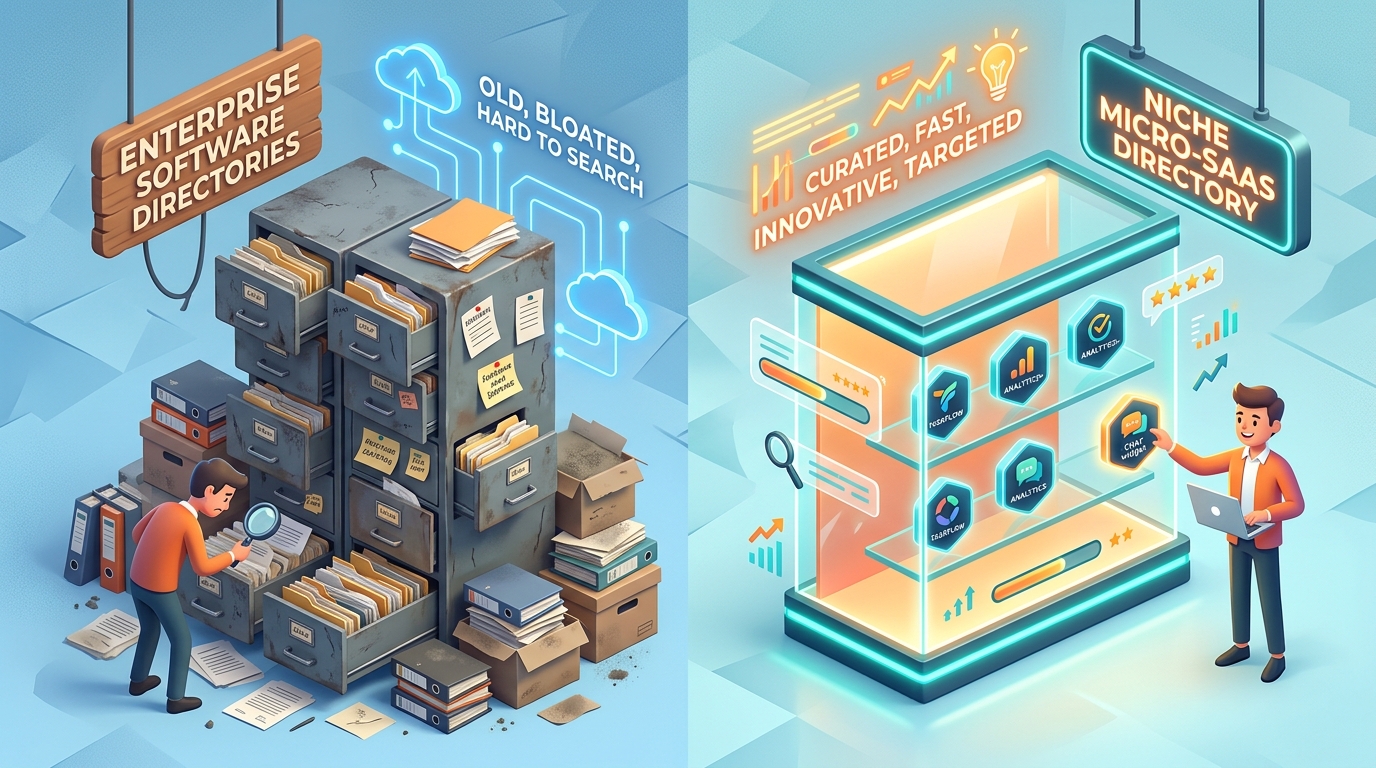
A micro-SaaS directory is a curated catalog of small, highly focused software products built by solo founders or small teams. Unlike massive review sites like G2 or Capterra that cater to enterprise software and rely on paid placements, a micro-SaaS directory focuses on discovering affordable, highly specialized tools tailored specifically for freelancers, bootstrapped startups, and indie hackers.
The Problem with Modern Software Discovery
Finding the right software tool for your business in 2026 is incredibly frustrating. If you go to Google and search for "best invoicing software," you will be immediately bombarded by full-page advertisements from massive, multi-billion dollar corporations like QuickBooks, FreshBooks, or Xero.
If you scroll past the ads and click on an organic search result, you will likely land on a massive software review aggregate site. These sites claim to offer unbiased reviews of the "Top 10" tools in any given category. However, the reality of how these sites operate is an open secret in the tech industry: they are "pay-to-play." The enterprise companies with the largest marketing budgets pay tens of thousands of dollars to ensure their software is listed at the #1 spot.
This creates a massive blind spot in the market. What if you don't need a massive, bloated enterprise suite? What if you are a freelance graphic designer who just needs to send three simple PDF invoices a month? You don't need QuickBooks, and you certainly don't want to pay $40 a month for it.
You need a micro-SaaS. You need a small, beautifully designed tool built by a solo developer that does exactly one thing (invoicing) exceptionally well, and only costs $5 a month (or better yet, a one-time lifetime fee).
The problem is that this solo developer doesn't have a $50,000 monthly marketing budget to outbid QuickBooks on Google Ads or pay for premium placement on massive review sites. Their brilliant software remains hidden.
This is the exact problem that a micro-SaaS directory solves. It acts as a specialized discovery engine, shining a spotlight on the hidden gems of the software world that you would never find through traditional search engines.
How is a micro-SaaS directory different from G2 or Capterra?
To understand the value of a micro-SaaS directory like MicroBaseHQ, you have to understand the fundamental business model differences between it and a traditional enterprise directory like G2 or Capterra.
The Business Model
Traditional software directories are essentially B2B (Business to Business) lead generation machines. Their customer is not the person searching for software; their customer is the software company itself. Enterprise SaaS companies pay these directories "Cost Per Click" (CPC) or "Cost Per Lead" (CPL) fees. When you search for "CRM software" on a traditional directory, the results are heavily skewed toward the companies willing to pay the highest CPC.
A micro-SaaS directory operates differently. Because the tools listed in a micro-SaaS directory are built by solo founders with tiny marketing budgets, the pay-to-play model doesn't work. Instead, micro-SaaS directories focus on organic curation. They are built by makers, for makers. The primary goal is to help small businesses discover affordable tools, rather than maximizing lead-gen revenue from enterprise giants.
The Scope of Software
If you look up a project management tool on an enterprise directory, you will find Jira, Asana, and Monday.com. These tools are incredibly powerful, but they are also incredibly complex. They require onboarding calls, dedicated account managers, and hours of configuration.
If you look up a project management tool on a micro-SaaS directory, you will find lightweight, opinionated tools that you can set up in 30 seconds. These are tools designed to solve a very specific pain point without the bloat.
The Review System
Enterprise directories rely on volume. They want thousands of reviews for every product. Unfortunately, this often leads to "gamified" review systems, where companies offer Amazon gift cards in exchange for five-star reviews.
Micro-SaaS directories tend to focus less on aggregate star ratings and more on qualitative curation. The tools are often hand-picked or vetted by the directory's maintainers to ensure they meet a certain standard of quality, usability, and indie-hacker ethos.
Why should you use a micro-SaaS directory to pick your software stack?
Building your software stack—the collection of tools you use to run your business—is one of the most important decisions you will make as a founder or freelancer. Choosing the wrong tools can result in thousands of dollars of wasted expenses and countless hours of frustration.
Here is why relying on a micro-SaaS directory is the smartest way to build your stack:
1. Massive Cost Savings
Enterprise software is priced for enterprises. If a SaaS company knows their tool is being used by a 500-person corporation, they will charge accordingly, often forcing you into "minimum seat" requirements or annual contracts.
Micro-SaaS tools are priced for individuals. Because the founders have very low overhead, they pass those savings on to you. You can often find a micro-SaaS tool that does exactly what an enterprise tool does, but for 10% of the cost. By browsing specific software categories on a micro-SaaS directory, you can build a complete business stack for under $50 a month.
2. Exceptional Customer Support
When you submit a support ticket to a massive software company, it goes into a queue, gets assigned to a Tier 1 support rep who reads from a script, and takes three days to resolve.
When you submit a support ticket to a micro-SaaS company, you are usually emailing the founder—the person who actually wrote the code. They care deeply about every single customer. If you find a bug, they will often fix it and deploy an update within hours. If you suggest a feature, they might build it for you that weekend. The level of personalized support you get from an indie hacker is unparalleled.
3. Laser-Focused Functionality
Micro-SaaS tools do not try to be everything to everyone. They embrace constraints. If you buy a micro-SaaS tool for tracking freelance time, it will be the best time-tracker you have ever used, but it won't try to also be your CRM, your invoicing tool, and your email client. This results in cleaner interfaces, faster load times, and a drastically reduced learning curve.
How do micro-SaaS directories curate their tool listings?
Not every piece of software qualifies as a micro-SaaS. If a directory simply accepted every single link submitted to it, it would quickly turn into a chaotic, unusable link farm. To maintain quality, a good micro-SaaS directory employs strict curation criteria.
While every directory is different, at MicroBaseHQ, we look for several key indicators before approving a tool for our platform:
1. Bootstrapped or Solo-Founded: We prioritize tools that are built by independent developers, small teams, or bootstrappers, rather than VC-backed startups.
2. Solves a Specific Niche Problem: The tool must have a clear, defined use case. If the marketing copy says "The all-in-one operating system for your entire life," it is probably too broad.
3. Transparent Pricing: Micro-SaaS tools should have clear, upfront pricing. If a tool hides its pricing behind a "Contact Sales for a Demo" button, it does not belong in our directory.
4. Modern UI/UX: The tool must look and feel like it belongs in the modern web era. It should be intuitive and fast.
5. Active Maintenance: We check to ensure the founder is actively maintaining the project, shipping updates, and responding to users. We do not list "abandonware."
By acting as a rigorous filter, the directory ensures that when you click on a tool, you are looking at a high-quality, viable option for your business.
What are the risks of using software from a micro-SaaS directory?
While the benefits are massive, we believe in being fully transparent about the realities of the micro-SaaS ecosystem. Using software built by a solo founder does carry some unique risks compared to using enterprise software.
The "Bus Factor"
The "bus factor" is a morbid tech industry term that asks: "If the lead developer gets hit by a bus tomorrow, what happens to the software?" In an enterprise company, another engineer takes over. In a micro-SaaS, if the solo founder gets sick, burns out, or simply loses interest in the project, the software might stop receiving updates.
Acquisition and Sunsetting
Many micro-SaaS tools are built with the explicit goal of being acquired by a larger company. When this happens, the acquiring company will often "sunset" (shut down) the tool, forcing you to migrate your data elsewhere. While this is frustrating, it is a risk inherent to using any software, large or small.
Infrastructure Scalability
If your own business explodes in growth and suddenly requires processing millions of data points a minute, a tool built by a solo developer might struggle to scale with you. Micro-SaaS tools are designed for small-to-medium workloads. If you become a massive enterprise yourself, you will eventually outgrow your micro-SaaS stack.
To mitigate these risks, always ensure that any micro-SaaS tool you use allows you to easily export your raw data (usually via CSV or JSON). As long as you can export your data, you are never truly trapped.
How can founders benefit from submitting their tool to a directory?
If you are an indie hacker or solo developer reading this, you might be wondering why you should bother listing your tool on a directory.
The hardest part of building a micro-SaaS is not writing the code; it is getting distribution. You can build the most beautiful, functional software in the world, but if your domain authority is zero and you have no Twitter following, nobody will ever see it.
Submitting your tool to a niche directory provides several massive benefits:
1. High-Intent Traffic: The people browsing a micro-SaaS directory are actively looking for software to buy. They have their credit cards out. A click from a directory is worth ten clicks from a random Reddit post.
2. SEO Backlinks: Getting a high-quality "dofollow" backlink from an established directory significantly boosts your own website's Domain Authority (DA). This helps your tool rank higher in Google's organic search results.
3. Social Proof: Being featured on a curated list alongside other high-quality tools provides immediate credibility to your brand.
If you have built a tool that solves a real problem, don't let it gather dust in a private GitHub repository. We highly encourage you to submit your tool to MicroBaseHQ so our community can discover it, use it, and pay you for it.
Frequently Asked Questions (FAQ)
How much does it cost to use a micro-SaaS directory?
For the user searching for software, a micro-SaaS directory is always 100% free to use. You can browse categories, read breakdowns, and discover tools without ever paying a dime or creating an account.
Are micro-SaaS tools safe to use?
Generally, yes. Most modern micro-SaaS tools use enterprise-grade third-party infrastructure for security. For example, they use Stripe to process payments (meaning they never actually see your credit card data) and services like Auth0 or Firebase for secure login authentication. However, you should always review a tool's privacy policy before uploading highly sensitive client data.
Can anyone submit a tool to a micro-SaaS directory?
Yes, anyone can submit a tool, but not every tool is accepted. The submission process usually involves filling out a form with your website URL, pricing details, and a description of the problem your software solves. The directory maintainers will then manually review the submission against their quality guidelines before publishing it.
How do I know if a tool is a micro-SaaS or a traditional SaaS?
The easiest giveaway is the pricing page. If the pricing is transparent, affordable (e.g., $9/month or a one-time fee), and lacks an "Enterprise: Contact Sales" tier, it is likely a micro-SaaS. Additionally, checking the "About Us" page will often reveal if it is run by a solo founder or a small indie team.
Do micro-SaaS directories include customer reviews?
Some do, but many focus primarily on editorial curation rather than crowdsourced star ratings. Because micro-SaaS tools have smaller user bases, crowdsourced review systems can easily be skewed by a single angry customer or artificially inflated by the founder's friends. Editorial curation provides a more balanced, objective overview of the tool's true capabilities.
How often are tools updated in a micro-SaaS directory?
A high-quality directory is updated weekly or even daily. The indie hacker ecosystem moves incredibly fast, with new tools launching on Twitter and Product Hunt every single day. Directories constantly scrape these platforms and accept user submissions to ensure their categories remain fresh and relevant.
Last updated: September 8, 2026