Micro-SaaS vs Traditional SaaS: What's Actually Different?
Is a micro-SaaS just a smaller version of a regular SaaS? Discover the fundamental differences in funding, audience, and features that separate the two.
Micro-SaaS vs Traditional SaaS: What's Actually Different?
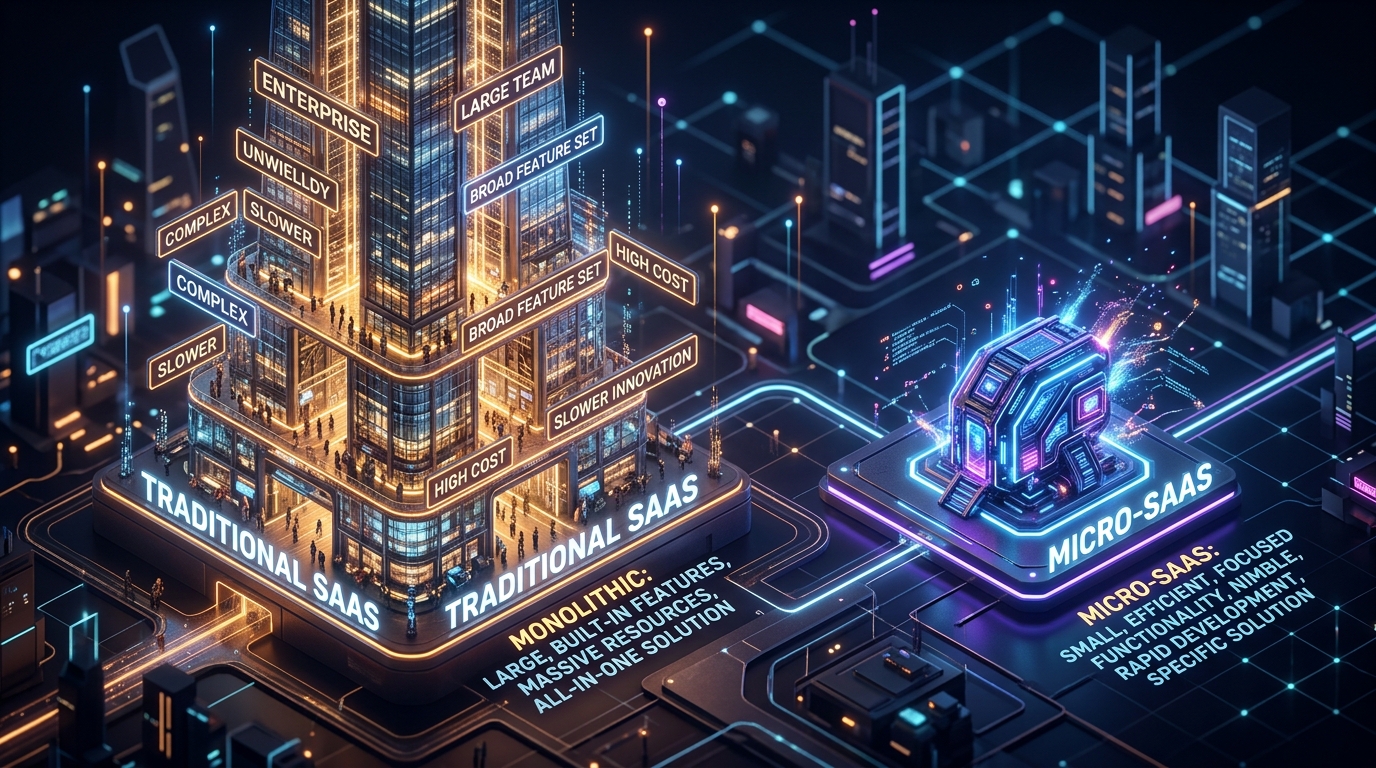
Is micro-SaaS just a smaller version of SaaS? No. While both models deliver software over the internet on a subscription basis, a micro-SaaS is fundamentally different in its business architecture. A traditional SaaS targets massive markets and relies on venture capital to fund large engineering teams. A micro-SaaS intentionally targets a highly specific, hyper-niche audience with a laser-focused feature set, designed to be operated profitably by a solo founder or a very small bootstrapped team with minimal overhead.
The Semantic Confusion
If you are new to the software industry, the terminology can be incredibly confusing. "SaaS" stands for Software as a Service. It simply means that instead of buying a CD-ROM at a physical store and installing a program on your computer, you log into a website and pay a monthly subscription fee to use the software.
Salesforce, Netflix, and Zoom are all SaaS companies. They are multi-billion dollar behemoths that employ tens of thousands of people.
Over the last decade, a new term emerged on indie hacker forums: "Micro-SaaS." To the untrained eye, the prefix "micro" simply implies a smaller revenue number or a smaller user base. Many people mistakenly believe that a micro-SaaS is just a traditional SaaS company that hasn't successfully grown up yet.
This is a fundamental misunderstanding of the business model. A micro-SaaS is not a failed or immature SaaS. It is an intentional, architecturally distinct business philosophy. The differences between the two models dictate everything from how the code is written to how the software is marketed and how the founder lives their daily life.
Let's break down the five core differences that separate a traditional SaaS from a micro-SaaS in 2026.
1. The Core Philosophy: Hyper-Niche vs Mass Market
The single most defining characteristic of a micro-SaaS is who it is built for.
Traditional SaaS: The Total Addressable Market (TAM)
When a founder pitches a traditional SaaS idea to a venture capital firm, the first question the investor asks is: "How big is the Total Addressable Market?" If the market isn't worth at least a billion dollars, the investor will pass. Traditional SaaS companies must solve broad, universal problems.
For example, Slack solves internal communication. Every single business on earth with more than two employees needs to communicate. Therefore, Slack's audience is practically infinite.
Micro-SaaS: The Riches are in the Niches
A micro-SaaS founder explicitly ignores the concept of a massive TAM. Instead of trying to build a product for everyone, they build a product for a hyper-specific subset of people.
A micro-SaaS founder does not build a generic "internal communication tool." A micro-SaaS founder builds an internal communication tool specifically designed for remote, freelance architectural firms who need native AutoCAD file previewing in their chat windows.
The audience for this tool might only consist of 5,000 architectural firms in the entire world. A venture capitalist would laugh at this market size. But if the solo founder can convince just 200 of those firms to pay $50 a month, they have built a business generating $120,000 a year in pure recurring revenue. By staying niche, the micro-SaaS avoids competing with giants like Slack and Microsoft entirely. (You can explore the various niche problems that micro-SaaS founders are solving in our directory).
2. Feature Bloat vs Laser Focus
Because their target audiences are so different, the actual software features of a traditional SaaS and a micro-SaaS look nothing alike.
Traditional SaaS: The All-In-One Trap
When a traditional SaaS company takes millions of dollars in venture funding, they are under immense pressure to grow revenue exponentially every single quarter. To justify raising their prices, they must constantly add new features.
Over the span of five years, a simple traditional SaaS email marketing tool will inevitably bolt on a CRM, a landing page builder, an SMS marketing suite, and a social media scheduler. The software becomes bloated, slow, and incredibly complex to navigate. This is known as "feature bloat," and it is the inevitable destiny of almost every VC-backed software company.
Micro-SaaS: Embracing Constraints
A micro-SaaS does one thing, and it does it exceptionally well. Because the tool is built by a solo founder, they literally do not have the engineering bandwidth to build 50 different features. They are forced to embrace constraints.
If a micro-SaaS is designed to convert PDF bank statements into Excel files, that is the only button on the screen. The interface is clean, lightning-fast, and instantly understandable. When a customer uses a micro-SaaS, they are paying for simplicity. They are explicitly paying not to deal with the 400 confusing dropdown menus found in an enterprise tool.
3. The Economics of Funding: Bootstrapping vs Venture Capital
The financial mechanics powering these two business models are fundamentally opposed, and this heavily dictates the stress levels of the founders involved.
Traditional SaaS: The Venture Capital Treadmill
Traditional SaaS is a capital-intensive game. You have to hire ten senior engineers at $150,000 salaries before you even launch the MVP. To afford this, the founders sell equity (ownership) of their company to Venture Capital (VC) firms.
Once you take VC money, you step onto a treadmill. The VCs expect a 10x return on their investment within seven years. This means the founder is under crushing, relentless pressure to grow at all costs. If the company is only growing 10% year-over-year, it is considered a catastrophic failure in the eyes of the board, and the founders may be fired from the very company they started.
Micro-SaaS: Bootstrapping and Cash Flow
A micro-SaaS is almost entirely "bootstrapped." This means the founder uses their own personal savings (or revenue from early customers) to fund the business. They own 100% of the company. They do not have a board of directors, and they do not have investors demanding a 10x return.
Because the infrastructure costs of running a modern web app are incredibly low (often under $50/month using the modern tech stack), a micro-SaaS can become profitable with just three paying customers. If a micro-SaaS generates $5,000 a month in profit and never grows another dollar for the next five years, it is an incredible, life-changing success for the solo founder. The stress is infinitely lower because the founder defines their own metrics for success.
4. Marketing Strategies: Enterprise Sales vs Community-Led Growth
The way you acquire a customer for a $10,000/year enterprise software contract is completely different than how you acquire a customer for a $15/month micro-SaaS.
Traditional SaaS: Top-Down Enterprise Sales
Traditional SaaS companies rely heavily on expensive outbound marketing and formal sales teams. They hire armies of SDRs (Sales Development Representatives) to cold-call executives. They host expensive steak dinners, sponsor massive industry conferences, and spend hundreds of thousands of dollars a month on Google Ads to outbid their competitors. The sales cycle can take six to nine months of negotiations before a contract is signed.
Micro-SaaS: Bottom-Up Community Growth
A solo founder does not have the budget to buy a billboard in San Francisco or take a VP of Marketing out to dinner. Micro-SaaS marketing is highly organic, scrappy, and community-led.
The founder relies heavily on SEO (Search Engine Optimization), building free tools as lead magnets, and genuinely engaging in niche communities on Reddit, Discord, or X (Twitter). The sales cycle is instantaneous: a user reads a helpful blog post, clicks a link, and immediately enters their credit card details for a $15/month subscription without ever speaking to a human being.
5. Exit Strategies: The IPO vs The Lifestyle Business
The end-game for these two business models looks completely different.
Traditional SaaS: The "Unicorn" IPO or Acquisition
The ultimate goal of a VC-backed traditional SaaS is an "Exit." The investors need to get their money back. This typically happens in one of two ways: the company grows massive enough to IPO (Initial Public Offering) on the stock market, or it gets acquired by an even larger tech giant (like Microsoft or Google) for hundreds of millions of dollars. If the company fails to achieve an exit, it is deemed a failure.
Micro-SaaS: The Lifestyle Asset
For many micro-SaaS founders, there is no "Exit Strategy" because they have no desire to leave. The micro-SaaS operates as a high-margin cash machine that requires very little daily maintenance. It is a "lifestyle business" that allows the founder to work four hours a week while generating a six-figure income, giving them the freedom to travel, spend time with their family, or start a second micro-SaaS.
However, if a micro-SaaS founder does want to sell, a massive ecosystem of micro-acquirers (like Acquire.com) exists. A micro-SaaS generating $100,000 in Annual Recurring Revenue (ARR) can typically be sold to a private buyer for a $300,000 to $400,000 upfront cash payout, allowing the founder to instantly retire or fund their next venture.
Which model should you choose to build?
There is no "wrong" choice. Both models have created immense wealth and solved massive problems for the world. The choice entirely depends on your personality, your risk tolerance, and your definition of a successful life.
If your dream is to ring the bell at the New York Stock Exchange, to manage a team of 500 brilliant engineers, to fly on private jets, and you are willing to endure a decade of sleepless nights and crushing board-level stress to get there, you should build a Traditional SaaS.
If your dream is to work from a laptop in a coffee shop in Bali, to answer to nobody but yourself, to have zero employees, to maintain complete ownership of your intellectual property, and to build a quiet, highly profitable machine that pays your rent while you sleep, you should build a Micro-SaaS.
If you decide to embark on the solo-founder route, be sure to explore our curated categories of software to see what other successful indie hackers are currently building.
Frequently Asked Questions (FAQ)
Can a micro-SaaS eventually grow into a traditional SaaS?
Yes, this happens frequently. A founder might start a highly niche micro-SaaS, realize the market demand is vastly larger than they anticipated, and decide to raise venture capital to capture that market quickly. At that point, they hire a massive team and the company officially transitions from a micro-SaaS into a traditional SaaS. Mailchimp is a famous example of a company that started as a bootstrapped side project and grew into a multi-billion dollar behemoth.
Do micro-SaaS companies use different programming languages?
Not necessarily. The underlying technology (JavaScript, Python, PostgreSQL) is exactly the same. However, micro-SaaS founders heavily favor high-productivity "Boring Stacks" (like Next.js and Supabase) that allow a single person to move quickly, whereas traditional SaaS companies often use highly complex, distributed architectures (like microservices in Go or Rust) designed to scale across massive engineering teams.
Is it less risky to start a micro-SaaS?
Financially, yes. Because you are not quitting your day job to hire ten engineers, your financial exposure is limited to your $15 domain name and your weekend time. If a micro-SaaS fails, the founder loses a few weekends. If a VC-backed SaaS fails, investors lose millions of dollars.
How many customers does a micro-SaaS typically have?
It varies wildly based on pricing, but the numbers are smaller than you might think. If your micro-SaaS charges a premium B2B price of $99/month, you only need exactly 84 customers to generate $100,000 in Annual Recurring Revenue (ARR). A micro-SaaS is highly profitable with hundreds of customers, not millions.
Can you run a micro-SaaS part-time?
Absolutely. In fact, over 80% of micro-SaaS products are started as "side hustles" while the founder maintains a full-time job. Because the software runs automatically in the cloud, the only daily maintenance required is answering a few customer support emails, which can easily be done on evenings or weekends.
Are profit margins higher in a micro-SaaS?
Yes, significantly. A traditional SaaS company often operates at a massive loss for the first five to ten years of its existence as it burns cash on marketing and salaries to acquire market share. A bootstrapped micro-SaaS, run by a single founder with no office space and no employee healthcare costs, often operates at a staggering 80% to 90% profit margin.
Last updated: September 8, 2026