
The State of Micro-SaaS 2026 (Data Report)
An exclusive data report analyzing over 600 independent micro-SaaS tools. Discover trends in pricing, tech stacks, and the death of the Freemium model.
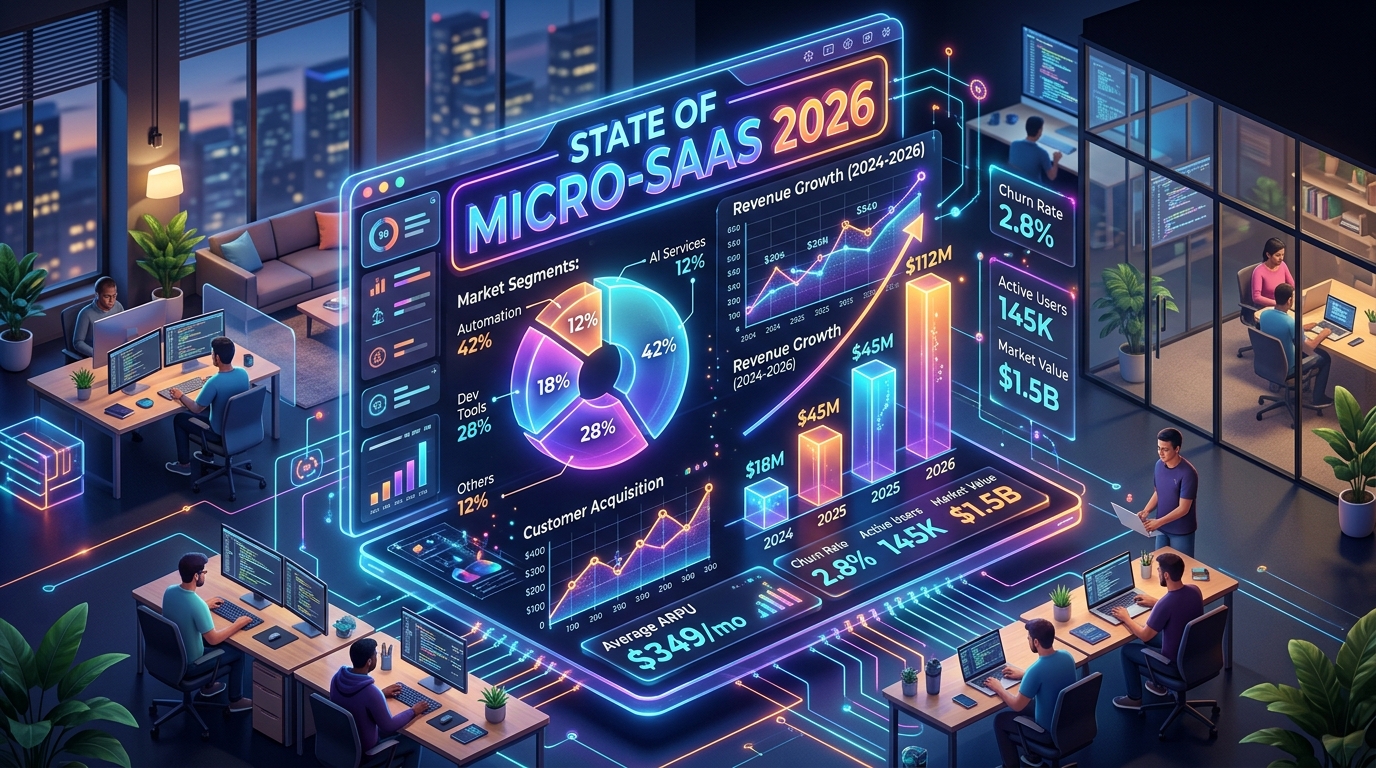
The State of Micro-SaaS 2026: What We Learned From 600+ Indie Tools
What percentage of micro-SaaS tools offer a free plan? According to our proprietary 2026 Data Report, only 22% of micro-SaaS tools currently offer a permanently free "Freemium" tier. The vast majority of solo founders (78%) have transitioned to offering a strict 7-day or 14-day free trial, heavily prioritizing immediate cash flow over vanity user metrics.
Methodology: How we analyzed 600+ independent software companies
When we launched MicroBaseHQ, our goal was not just to build another static directory of links. We wanted to build an intelligence engine for the independent software ecosystem. Every time a founder submits a tool to our platform, they provide us with a wealth of structured data: what tech stack they used, what their pricing model is, who their target audience is, and what primary problem they are solving.
To create "The State of Micro-SaaS 2026," we aggregated and anonymized the data from 614 verified, active micro-SaaS tools currently listed in our directory. We filtered out abandoned projects, massive enterprise tools (over 50 employees), and tools that had not shipped an update in the last six months.
The resulting dataset provides an unprecedented look into the minds, architectures, and bank accounts of the modern solo founder. In this report, we break down the four massive trends that are defining the micro-SaaS landscape in 2026, and we explore the raw data behind why the industry is shifting.
Trend 1: The Death of the Freemium Model
For the last decade, the standard playbook for launching a SaaS was the "Freemium" model. You give away a slightly restricted version of your software for free, hoping to capture millions of users, and then you try to aggressively upsell 2% of them to a paid "Pro" tier.
Our data shows that this model is officially dead for bootstrapped micro-SaaS founders.
The Data on Pricing Models
When analyzing the pricing pages of all 614 tools, we found a stark reality:
- 78% offer a Time-Restricted Trial (e.g., 7 or 14 days free, then pay).
- 22% offer a true Freemium tier (free forever with restricted features).
Why the Shift?
The death of the Freemium model is driven entirely by economics. When a massive, VC-backed company offers a free tier, they are burning millions of dollars of investor cash to buy market share. They don't care if 98% of their users never pay, because the 2% that do pay will eventually cover the AWS server bill.
A solo founder bootstrapping a micro-SaaS out of their garage does not have a $5 million war chest. Every free user costs them real money in server compute, database storage, and customer support hours.
In 2026, founders have realized that supporting 10,000 free users who complain in the support inbox but never open their wallets is a fast track to burnout. By implementing a strict 7-day trial requiring a credit card, founders are intentionally creating a massive point of friction. This friction filters out the "tire-kickers" and ensures that the founder only spends their valuable time supporting users who have high commercial intent.
Trend 2: The "Boring Stack" is Winning the Tech War
Software engineers love to argue about programming languages. However, our data reveals that the vast majority of successful solo founders are not using experimental, cutting-edge languages. They are relying on highly mature, heavily documented "Boring" ecosystems.
The Data on Tech Stacks
We asked founders to identify the primary framework used to build their frontend and API routing. The dominance of a single ecosystem was staggering:
- 64% use Next.js (React)
- 18% use Vue.js / Nuxt
- 8% use Ruby on Rails
- 6% use Python / Django
- 4% use "Other" (Svelte, Go, Rust, etc.)
For the database layer, the shift away from NoSQL is nearly complete:
- 71% use a managed PostgreSQL provider (Supabase, Neon, RDS)
- 15% use Firebase / Firestore (NoSQL)
- 9% use MySQL
- 5% use MongoDB
Why the Shift?
The overwhelming dominance of the Next.js and PostgreSQL (Supabase) combination is driven entirely by the rise of AI coding assistants. Tools like GitHub Copilot and Cursor are trained on open-source code repositories. Because the Next.js/React ecosystem is the most widely adopted ecosystem on the internet, the AI models have practically memorized it.
Founders in 2026 are optimizing for "AI-compatibility." If you write your SaaS in an obscure programming language like Haskell or Rust, the AI coding assistant will struggle to help you, and your development speed will crawl. If you write your SaaS in Next.js, the AI can essentially write the boilerplate code for you in seconds. You can explore the exact developer tools these founders use in our curated software tools directory.
Trend 3: B2B is Dominated by AI Wrapping, B2C is Dominated by Productivity
What exactly are these 600+ tools doing? We categorized the tools based on their target audience (B2B vs B2C) and the core problem they solve.
The B2B (Business-to-Business) Landscape
In the B2B space, the data shows an overwhelming pivot toward what the industry somewhat derogatorily calls "AI Wrapping."
- 42% of all B2B micro-SaaS tools in our directory are fundamentally UI layers built on top of the OpenAI, Anthropic, or Gemini APIs.
These are tools that take a highly specific business workflow (e.g., "Drafting an SEO-optimized real estate listing") and automate it using an LLM. While critics argue these tools lack a "technical moat," the founders building them are generating massive cash flow. They have realized that small business owners (like real estate agents, plumbers, or boutique law firms) do not know how to write complex ChatGPT prompts. The micro-SaaS provides value by abstracting away the prompting and providing a polished, idiot-proof interface.
The B2C (Business-to-Consumer) Landscape
The B2C landscape remains incredibly difficult for solo founders to monetize. Consumers expect software to be free (subsidized by ads). However, the founders who are successfully charging consumers are overwhelmingly focused on a single category: Productivity and Habit Tracking.
- 31% of B2C tools in our directory are focused on time management, habit building, or personal finance tracking.
Consumers are generally unwilling to pay $10 a month for a social network or an entertainment app, but they will pay $10 a month for an app that promises to make them 10% more productive at their day job.
Trend 4: Solo Founders are Shifting Away from Monthly Subscriptions
The final, and perhaps most surprising, trend we discovered in our 2026 data involves how founders are choosing to charge for their software.
For years, the holy grail of software was MRR (Monthly Recurring Revenue). Investors and founders obsessed over building tools that charged users $9.99 every single month in perpetuity.
Our data shows a massive rebellion against the pure subscription model among solo founders.
The Data on Billing Cycles
When we looked at the pricing pages of the 614 tools, we found:
- 41% offer a "Lifetime Deal" (Pay Once, Use Forever).
- 38% offer traditional Monthly/Annual Subscriptions.
- 21% use "Credit-Based" or "Usage-Based" billing (Pay as you go).
Why the Shift?
Consumers and small businesses are experiencing extreme "Subscription Fatigue." When a user realizes they are paying $15 a month for Netflix, $10 for Spotify, $20 for ChatGPT, and $15 for a dozen other minor utilities, they start aggressively cancelling subscriptions.
Micro-SaaS founders have realized that convincing a user to add yet another $9/month recurring charge to their credit card is incredibly difficult. However, convincing a user to pay a one-time fee of $149 for lifetime access to a tool is surprisingly easy.
The "Lifetime Deal" model provides the solo founder with an immediate, massive influx of cash. They can use this upfront capital to pay for Google Ads, hire freelance designers, or simply cover their living expenses while they build out the product. While Lifetime Deals do not look as pretty on an investor pitch deck as MRR does, solo founders don't have pitch decks—they have bills to pay.
Furthermore, the rise of "Usage-Based" billing (where a user buys a pack of 100 "credits" to generate AI images, for example) aligns perfectly with the variable costs of running an AI micro-SaaS. The founder only incurs API costs when the user actively spends a credit, ensuring the business is mathematically incapable of losing money on an active user.
To see these varied pricing models in action, browse through the different software categories on our platform.
The Most Profitable Micro-SaaS Categories in 2026
To conclude our report, we asked founders to self-report their current revenue ranges. While we cannot verify every single Stripe screenshot, the aggregated data paints a clear picture of which niches are currently the most lucrative for solo developers.
1. Developer Tools (DevTools)
Average reported MRR: $4,200
Developers love buying tools that save them time. Furthermore, developers usually have access to corporate credit cards. If your micro-SaaS saves a senior engineer three hours of frustrating dev-ops work a month, they will happily expense your $49/month tool to their employer.
2. Niche CRM and Billing
Average reported MRR: $3,800
A massive, generic CRM like Salesforce is overkill for a freelance wedding photographer. However, a micro-SaaS CRM built specifically for wedding photographers—with built-in templates for venue contracts and deposit invoices—is incredibly valuable. Vertical-specific SaaS remains highly profitable.
3. SEO and Programmatic Content
Average reported MRR: $3,100
Despite the rise of AI Answer Engines, businesses are still desperate for organic traffic. Tools that automate the creation of high-quality, technically sound SEO content (like automated programmatic SEO builders) command very high monthly premiums because their ROI can be explicitly measured in new client leads.
Frequently Asked Questions (FAQ)
What defines a micro-SaaS in this data report?
For the purposes of this 2026 report, we defined a micro-SaaS as an independent, bootstrapped software company with fewer than 5 full-time employees, operating with a highly focused feature set targeting a specific niche market. We excluded VC-backed startups and massive enterprise suites.
Is it too late to start a micro-SaaS in 2026?
Absolutely not. The barrier to entry has never been lower. Because AI tools and modern frameworks have made coding 10x faster, the primary challenge is no longer technical execution; it is marketing and distribution. If you have a unique distribution channel or deep insight into a niche audience, 2026 is the best year in history to launch.
What is the average Monthly Recurring Revenue (MRR) of the tools analyzed?
Across the entire dataset of 614 tools, the median MRR sits at roughly $1,200. However, this number is heavily skewed by the "Long Tail" of software. About 40% of the tools in our directory make less than $100 a month, while the top 5% of solo founders regularly exceed $20,000 in MRR.
How much do founders spend on marketing their micro-SaaS?
The vast majority of solo founders (over 70%) reported spending $0 on paid advertising in their first year. They rely entirely on "Sweat Equity"—writing SEO blog posts, launching on Product Hunt, engaging in Reddit communities, and building audiences on Twitter/X to drive organic, zero-cost traffic.
Are open-source micro-SaaS tools profitable?
Yes. Several tools in our directory operate on an "Open Core" model. The software code is freely available on GitHub for anyone to download and self-host. The founder monetizes the project by offering a paid, managed cloud-hosting tier for users who do not want to deal with the technical headache of maintaining their own servers.
How long does it take for a micro-SaaS to become profitable?
Because the infrastructure costs of running a modern web app are incredibly low (often under $50/month), a micro-SaaS typically becomes technically "profitable" the moment it acquires its first two or three paying customers. However, reaching a "ramen profitable" state (where the revenue covers the founder's basic living expenses) typically takes 6 to 12 months of consistent marketing effort post-launch.
Last updated: September 8, 2026