How AI and 'Vibe Coding' Are Changing What a Solo Founder Can Build
Explore how AI coding assistants and 'vibe coding' are revolutionizing the micro-SaaS industry, allowing solo founders to build complex applications in days instead of months.
How AI and "Vibe Coding" Are Changing What a Solo Founder Can Build
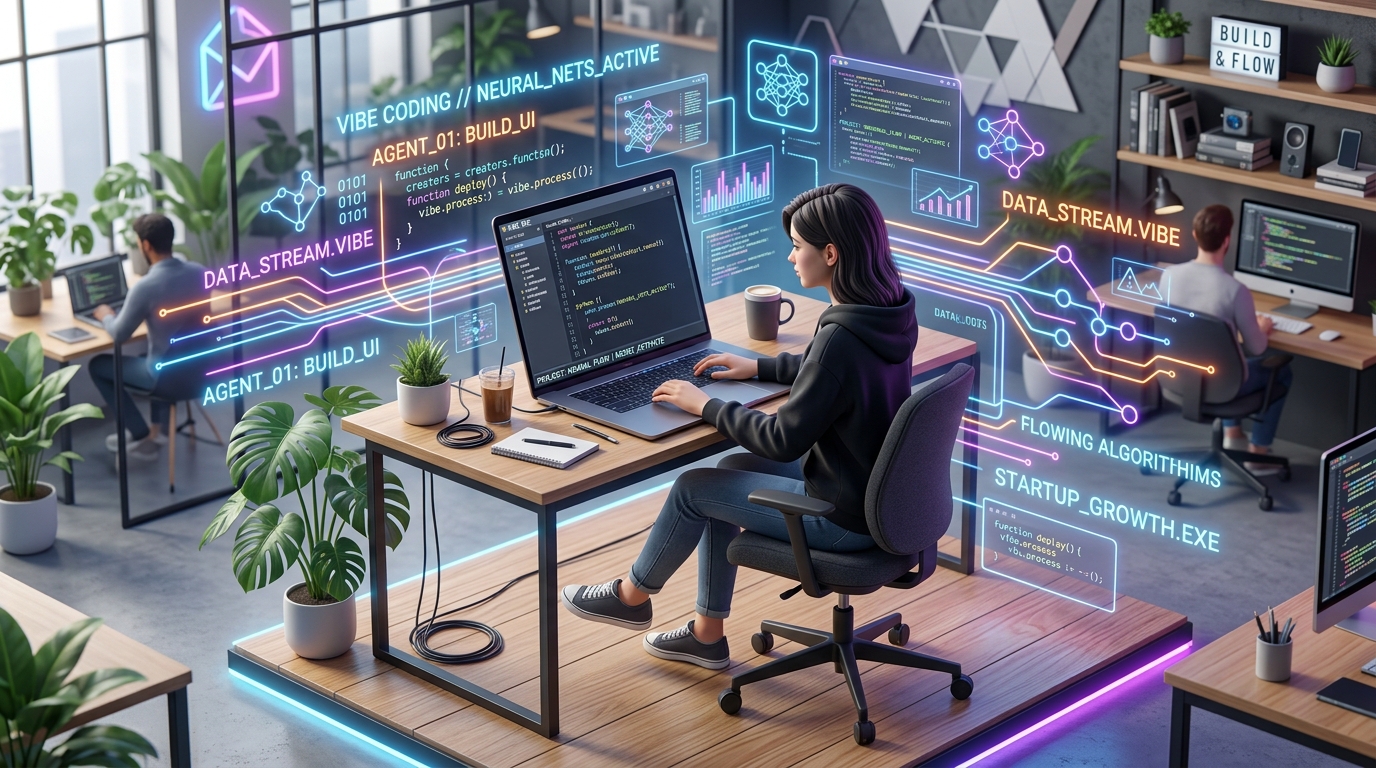
What is vibe coding, and can it replace a developer? Vibe coding is a modern software development approach where a human uses natural language to describe the desired "vibe," layout, or outcome of an application, while an AI assistant (like Cursor or GitHub Copilot) generates the underlying code. While it cannot entirely replace a senior developer for complex, distributed architectural logic, it dramatically accelerates the speed at which a solo founder can prototype and launch a micro-SaaS MVP.
The Evolution of the Solo Founder
To understand the magnitude of the shift occurring in the software industry right now, we have to look back at what it meant to be a "solo founder" just ten years ago.
In 2016, if you wanted to build a SaaS application by yourself, you had to be a polymath. You needed deep expertise in database architecture to set up your PostgreSQL schemas. You needed to understand complex backend routing to build an Express server. You needed to be a frontend wizard to center a div using raw CSS. And if you somehow managed to write all that code, you then had to learn server dev-ops just to deploy the application to AWS.
Because the cognitive load was so impossibly high, the term "solo founder" was practically synonymous with "burnout." Most successful SaaS companies were started by at least two co-founders: a technical CTO who locked themselves in a basement to write code, and a CEO who actually talked to customers.
In 2026, the landscape has fundamentally shifted. The barrier to entry for building complex software has collapsed to near zero, entirely because of the advent of Large Language Models (LLMs) and specialized AI coding assistants. This shift has given rise to a wildly controversial new paradigm in the developer community: Vibe Coding.
What exactly is "Vibe Coding"?
"Vibe Coding" is a slightly tongue-in-cheek term that originated on tech Twitter, but it perfectly encapsulates how modern software development actually feels when augmented by AI.
Historically, programming required a human to translate their abstract thoughts into incredibly rigid, unforgiving machine syntax. If you missed a single semicolon, the entire application would crash, and the computer would refuse to tell you why.
Vibe Coding flips this dynamic. Instead of the human learning the computer's language, the computer has learned the human's language.
When a founder is Vibe Coding, they are not meticulously typing out standard for loops or remembering the exact syntax for a React useEffect hook. Instead, they are acting more like an Art Director or a Product Manager. They provide the AI with a "vibe" or an overarching instruction:
"I need a clean, minimalist dashboard. Put a sidebar on the left with navigation links. In the main content area, I want a data table that fetches the last 5 invoices from the Supabase database. Make the table headers bold and use Tailwind CSS for a dark mode aesthetic."
The AI assistant instantly processes this natural language request and generates 150 lines of perfectly formatted React code. The founder reviews the code, perhaps tweaks a color variable to better match their brand, and hits deploy. They have successfully built a feature not by writing code, but by curating code generated from a vibe.
How Vibe Coding Accelerates Micro-SaaS Development
For a solo founder, time is the only resource that matters. Vibe coding provides three distinct, massive advantages that allow a single person to achieve the output of a small engineering team.
1. Eliminating the "Blank Page" Syndrome
The hardest part of any creative endeavor, including software engineering, is starting from zero. Staring at an empty index.js file and trying to architect an entire application from scratch is incredibly daunting.
AI completely eliminates the blank page. A founder can use an AI tool to instantly generate the entire boilerplate architecture of their application. Within 30 seconds, they have a functioning (albeit generic) application structure with routing, authentication, and database connections already wired up. This provides massive psychological momentum. It is significantly easier to edit and refine existing code than it is to write it from scratch.
2. Democratizing Full-Stack Development
Very few human beings are true "full-stack" experts. Most developers strongly prefer either the frontend (UI/UX, React, CSS) or the backend (Databases, API logic, Security).
Vibe coding acts as a profound equalizer. If you are a brilliant frontend designer with a great idea for a micro-SaaS, you no longer need to hire a $150/hour backend engineer to write your PostgreSQL database queries. You simply ask your AI assistant to write the database logic for you. Conversely, if you are a backend data scientist who struggles to make things look pretty, you can ask the AI to wrap your raw data in beautifully styled Tailwind CSS components.
By filling in your knowledge gaps, AI allows you to operate as a highly effective full-stack engineer, significantly reducing the cost of building an MVP. (To explore the specific frameworks that work best with AI, check out our guide on the best tech stacks).
3. Rapid Iteration and Bug Fixing
Before AI, debugging was an agonizing process. If a variable returned undefined, a developer might spend three hours reading obscure Stack Overflow threads from 2014 trying to find a solution.
Today, if you encounter an error, you simply highlight the broken code, paste the terminal error message into your AI assistant, and ask, "Why is this breaking?" The AI will instantly analyze the context, identify the logic flaw, and provide the exact corrected code. This reduces the debugging loop from hours to seconds, allowing solo founders to maintain massive momentum and ship new features daily.
The Limitations: Why Human Intuition Still Matters
With all this hype, a massive existential panic has swept through the software engineering community. Junior developers are terrified that they will be replaced by ChatGPT, and non-technical founders are operating under the delusion that they can build the next Airbnb without knowing a single thing about how computers work.
The reality of vibe coding is much more nuanced. AI is an amplifier, not an autopilot.
If you ask an AI to write a simple "To-Do List" application, it will do it flawlessly. If you ask an AI to architect a highly secure, globally distributed micro-SaaS that processes millions of financial transactions per minute with zero data loss, the AI will confidently generate spaghetti code that will collapse the moment it hits production.
AI lacks systemic intuition.
An LLM works by predicting the next most logical word or line of code based on its training data. It does not actually understand your business logic. It does not know that if it changes the database schema on line 45, it needs to update the caching invalidation logic on line 800 to prevent user data from leaking.
This is why human developers are not obsolete. The role of the developer is shifting from "Code Typist" to "Systems Architect." The solo founder of 2026 must possess a deep, high-level understanding of how databases, APIs, and frontends communicate with one another. If you understand the architecture, you can use the AI to write the repetitive syntax for you. But if you do not understand the underlying systems, you will not even know what to ask the AI, and you will not know how to fix the code when the AI inevitably hallucinates.
How to Integrate AI Coding into Your Workflow
If you are a solo founder ready to embrace the vibe coding era, here is how you should structure your development workflow.
- Adopt an AI-Native IDE: Do not use traditional text editors. Download Cursor (a fork of VS Code built entirely around AI) or integrate GitHub Copilot deeply into your existing IDE. These tools provide "tab-autocomplete" that can predict entire blocks of code as you type.
- Use the "Boring Stack": As we discussed in our previous guides, AI models perform best when dealing with highly popular frameworks. If you build your SaaS using Next.js and Tailwind CSS, the AI will provide near-perfect suggestions. If you use a highly obscure language, the AI will hallucinate.
- Write "Prompt-Driven" Comments: Before you write code, write an English comment explaining exactly what the function should do. (e.g.,
// Fetch the latest 10 invoices from Supabase where the status is "paid", and sort them by date descending.) The AI will read your comment and instantly generate the code below it. - Code in Small Chunks: Do not ask the AI to "build the entire billing page." It will get confused. Ask it to build the pricing toggle switch. Then ask it to build the checkout button. Build your application brick by brick.
The Future of Software in 2026 and Beyond
We are entering a golden age for the micro-SaaS industry. Because the cost and time required to build software have effectively crashed, we are going to see an explosion of highly niche, hyper-specific software tools.
In the past, a software company had to target a massive Total Addressable Market (TAM) to justify the millions of dollars spent on engineering salaries. Today, a solo founder using vibe coding can spend a weekend building a CRM designed exclusively for left-handed dentists in Ohio. Because the development cost was near zero, the founder only needs 10 paying customers to make the venture highly profitable.
The founders who succeed in this new era will not be the ones who can write the most elegant, algorithmically complex code. The winners will be the founders who possess deep empathy for a niche audience, a ruthless focus on distribution, and the ability to use AI as a massive lever to out-ship their competition. (If you are building an AI-assisted tool, be sure to list it in our directory so our community can discover it).
Frequently Asked Questions (FAQ)
What are the best AI coding assistants in 2026?
Currently, the market is dominated by Cursor (a dedicated AI IDE) and GitHub Copilot (an extension for existing IDEs). Both tools leverage advanced models from OpenAI and Anthropic to provide inline code completion, codebase chatting, and automated bug fixing.
Do I need to know how to code to use vibe coding?
Yes and no. You do not need to memorize exact syntax, but you must understand fundamental programming concepts (variables, loops, arrays, APIs, database relations). If you don't know the difference between a frontend and a backend, the AI cannot help you build a secure SaaS. It is an accelerator for developers, not a magic wand for non-technical users.
Will AI write bad or insecure code?
Yes, absolutely. AI models prioritize providing an answer over providing the most secure answer. They will frequently suggest code that is vulnerable to SQL injection or Cross-Site Scripting (XSS) if you do not explicitly instruct them to use secure, parameterized methods. A human must always audit AI-generated code before pushing it to production.
How much do AI coding tools cost?
Most professional AI coding assistants operate on a subscription model, typically ranging from $10 to $20 per month. Considering they can save a developer dozens of hours a week, it is arguably the highest ROI software subscription a solo founder can purchase.
Can AI deploy the code to a live server?
While the AI can write the code and provide you with the terminal commands needed for deployment, the actual act of deploying code to a platform like Vercel or AWS still requires human intervention to set up hosting accounts, configure environment variables, and manage domain DNS records.
Will vibe coding make software engineering obsolete?
No. It will simply shift the required skill set. Decades ago, "computers" were actual human beings who did math by hand. When electronic calculators were invented, mathematicians didn't go extinct; they just started solving much harder problems. AI is simply the calculator for software engineering. It automates the tedious syntax, allowing developers to focus entirely on high-level architecture and creative problem-solving.
Last updated: September 8, 2026